Something feels off. Not catastrophically wrong — just quietly, persistently off. You find yourself constantly calibrating your mood to someone else's. You can't remember the last time you made a decision without first gauging how it would land with your partner. You call it love. You call it loyalty. But somewhere underneath all that devotion is a question you've been afraid to ask: *Is this healthy, or am I disappearing?*
Codependency is one of the most misunderstood dynamics in modern relationships. It doesn't announce itself with obvious cruelty or dramatic scenes. It creeps in quietly — through small sacrifices that compound, through an identity that slowly folds itself around another person's needs, through the gradual erosion of your own internal compass.
This article breaks down the real signs you are in a codependent relationship — not the oversimplified checklist version, but the nuanced, emotionally honest picture of what it actually looks and feels like from the inside.
---
What Codependency Actually Means
The clinical roots of codependency trace back to research on families dealing with addiction, where one person's dysfunction pulled others into an enabling orbit. But the term has expanded considerably. Today, codependency describes a relational pattern where one person's emotional wellbeing becomes chronically dependent on the state of another — and where that dependency drives behavior in ways that are ultimately self-defeating.
It's not about loving someone deeply. Deep love is healthy. Codependency is when the relationship becomes the central organizing principle of your psychological life — when your sense of worth, safety, and identity hinges on the other person's approval, stability, or need for you.
There are two roles commonly at play. The person who over-gives, over-caretakes, and self-erases. And the person who — consciously or not — receives that caretaking without reciprocating it. The dynamic can persist for years, even decades, because it mimics closeness. It feels like intimacy. It feels like being needed. It feels, on some days, like the most important thing in the world.
But it isn't intimacy. It's enmeshment.
---
The Core Signs to Recognize
1. Your emotional state is directly governed by theirs
If your partner is anxious, you become anxious. If they're in a good mood, you feel relief — not because you're empathetic, but because their calm means you're safe. You've essentially outsourced your emotional regulation to another human being. This is one of the most telling signs you are in a codependent relationship, and it's exhausting in a way that's difficult to articulate to anyone on the outside.
2. You have an overwhelming need to be needed
There's a difference between wanting to support someone and needing them to need you. In codependency, the caretaker role isn't just something you do — it's who you are. The idea of your partner not needing you feels threatening. If they become more independent, more stable, or more capable, some part of you panics. Your worth in the relationship is tied to being indispensable.
3. Saying "no" feels physically dangerous
Not uncomfortable. Dangerous. The anticipation of your partner's disappointment, anger, or withdrawal creates a physiological stress response. So you say yes. Always. To things that violate your values, drain your time, and compromise your needs. And then you resent it — quietly, in a place you don't show anyone.
4. You've lost track of your own opinions, preferences, and desires
Ask yourself: What do *you* want for dinner? What kind of vacation would *you* choose? What are your actual political views, independent of your partner's? If these questions feel strangely difficult — if you find yourself instinctively scanning for what they would want before you can access your own answer — that's a significant signal.
5. You make excuses for behavior that hurts you
Codependent relationships often involve an asymmetry of accountability. One partner's bad behavior gets contextualized, minimized, or explained away by the other. "They're under a lot of stress." "That's just how they were raised." "They didn't mean it like that." The explanations aren't wrong, exactly — context matters. But when explanation becomes a permanent shield against accountability, it's a pattern worth examining.
!Person reflecting alone by a window

6. Conflict feels existential
In healthy relationships, disagreement is uncomfortable but survivable. In codependent ones, conflict feels like the relationship itself is dying. This amplified threat response drives behaviors like people-pleasing, conflict avoidance, and premature capitulation — not because you genuinely changed your mind, but because the anxiety of discord became unbearable.
7. You've reorganized your life around their needs
Friendships dropped. Career opportunities declined. Hobbies abandoned. Family relationships strained. Not because of dramatic ultimatums necessarily, but through a long series of small accommodations that, taken together, mean your life has contracted significantly around one person's orbit.
8. You monitor, manage, and control — even with love as the motive
This one is uncomfortable to admit. Codependent caretakers often become controlling — checking in constantly, managing the other person's emotions, trying to preempt problems before they arise. It comes from love and fear in equal measure. But it's still a form of control, and it prevents genuine autonomy on both sides.
9. Guilt is your default emotional response to self-care
Taking a weekend for yourself feels selfish. Spending money on something you want feels irresponsible. Having a need — any need — feels like an imposition. This pervasive guilt around self-care is one of the quieter, more corrosive signs of codependency, because it makes healthy boundaries feel morally wrong.
10. You can't imagine your identity outside this relationship
Who are you without this person? If that question creates genuine dread or blankness — not just sadness, but a kind of identity vertigo — the relationship has likely consumed a significant portion of your sense of self.
---
Why Codependency Is So Hard to See from the Inside
The central cruelty of codependency is that it activates the same neural pathways as genuine love and care. Sacrifice feels noble. Putting someone else first feels virtuous. Being needed feels meaningful. These aren't wrong instincts — they're deeply human ones. Codependency hijacks them.
There's also often a historical dimension. Many people who develop codependent patterns grew up in environments where emotional volatility, unpredictability, or someone else's needs dominated the household. They learned early that love required performance, that safety required vigilance, and that their own needs were secondary to managing the emotional weather of the adults around them. That learned architecture gets carried, often unconsciously, into adult relationships.
This is why intellectual recognition — reading a checklist, understanding the concept — rarely produces immediate change. The pattern lives in the body and the nervous system, not just the mind.
---
The Trade-offs at the Center of This Decision
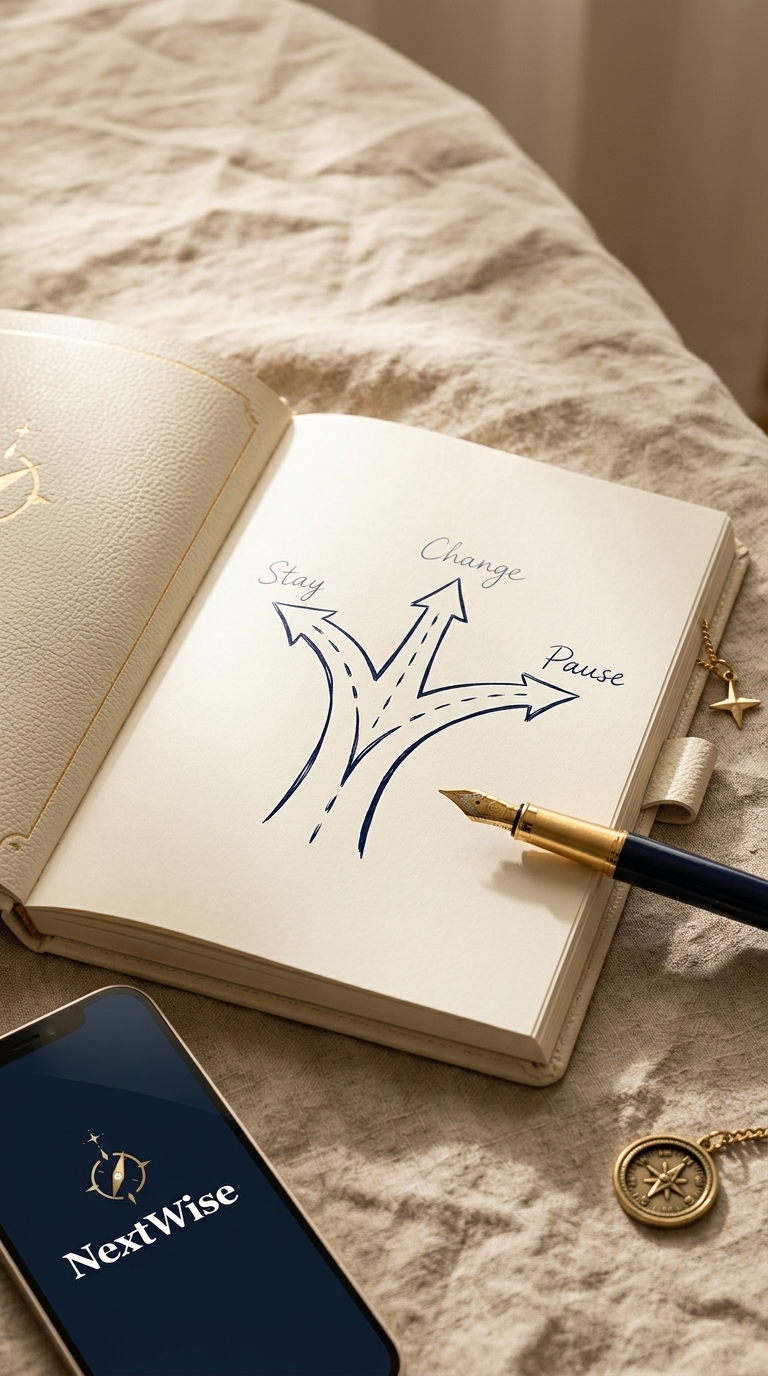
If you've recognized yourself in any of this, you're likely facing a decision that doesn't have a clean answer. Staying and trying to change the dynamic requires sustained effort, probable conflict, and uncertain outcomes. Leaving means confronting grief, upheaval, and the discomfort of rebuilding an identity.
But here's what often gets missed in that binary framing: the actual first decision isn't *stay or leave*. It's *see clearly or keep avoiding clarity*.
Most people in codependent relationships have never actually mapped the situation with honest, unflinching precision. They operate on a fog of feeling — exhaustion mixed with love, resentment mixed with fear, hope mixed with evidence to the contrary. Getting clear about what's actually happening — separating facts from assumptions, naming the risks, identifying what a realistic path forward looks like — is the prerequisite to any good decision.
!Decision fork on paper — facing a crossroads
---
How NextWise Can Help You Map This
NextWise is a decision-clarity tool built specifically for the moments when your thoughts are too tangled to trust, and the stakes are too high to wing it.
When you're facing a relationship decision as emotionally loaded as this one, NextWise runs it through a 3-Layer Filter:
Layer 1 — Facts vs. Assumptions: Most relationship pain is a mixture of real events and stories we've constructed around them. This layer helps you separate what's objectively true from what you've inferred, feared, or filled in with imagination. It's a surprisingly liberating exercise.
Layer 2 — Risks & Blindspots: Where are you most likely to deceive yourself? What are the risks of staying in this pattern that you might be minimizing? What are the risks of disruption that you might be catastrophizing? This layer surfaces what your emotional proximity to the situation is causing you to miss.
Layer 3 — 7-Day Action Plan: Not a five-year plan. Not a grand transformation manifesto. Just the next seven days — specific, manageable actions that move you toward clarity and agency, regardless of what you ultimately decide.
NextWise doesn't tell you what to do. It helps you hear yourself more clearly.
---
Practical Starting Points — Right Now
Regardless of whether you use a tool or not, there are things you can begin today:
Start noticing without judging. Before you can change anything, you need an accurate picture. Spend one week simply observing — when do you override your own needs? When do you feel that anxious scanning for approval? Write it down without editorializing.
Reintroduce yourself to your own preferences. Small things matter here. Choose a restaurant without consulting your partner. Make a weekend plan that's entirely about what *you* want. These micro-experiments in preference-recovery are more important than they sound.
Name the resentment. Resentment is almost always a sign that a boundary has been violated — usually repeatedly, usually without acknowledgment. Where are you resentful? That's your map to where your needs have been systematically deprioritized.
Consider professional support. A therapist who specializes in relational patterns and attachment can accelerate this process significantly. This isn't a sign of weakness — it's a sign that you're taking the situation seriously enough to get real help.
Have the honest conversation — with yourself first. Before you say anything to your partner, be honest with yourself about what you actually want and what you're actually experiencing. Most people in codependent relationships have never been fully honest with themselves, because honesty felt too threatening.
---
A Note on Compassion
If you've recognized yourself in these signs, resist the urge to immediately convert recognition into self-condemnation. Codependency is not a character flaw. It's an adaptive pattern that made sense at some point in your history — and like all adaptive patterns, it can be examined, challenged, and changed.
The same compassion you've been pouring outward — toward your partner, toward the relationship, toward everyone but yourself — is available to be redirected. You're allowed to extend it inward.
Clarity is not the enemy of love. It's often the only thing that can rescue it.
---
> Ready to get clear about where you actually stand? > > NextWise helps you map your relationship decision with structure, honesty, and zero judgment. > > → Start your Relationship Clarity Map now
---
The question isn't whether you love this person. You probably do, deeply. The question is whether the way you're relating to each other is actually working — for both of you, not just one. That question deserves a real answer. Not a rushed one, not a fear-driven one, but a clear one.
You can find it. But you have to be willing to look.