By mid-afternoon, most people are not tired from their work. They are tired from the sheer volume of choices they have already made. What to eat. Whether to reply. Which meeting to reschedule. How to respond to that message that has been sitting in the inbox since Tuesday. Decision fatigue is not dramatic. It does not announce itself. It quietly erodes the quality of every choice you make after a certain threshold — and it tends to hit hardest precisely when the stakes are highest.
This article is about understanding that threshold, and more importantly, about building a life where your best thinking is available when it actually matters.
---
What Decision Fatigue Actually Is (And What It Isn't)
Decision fatigue is not indecisiveness. It is not a personality flaw or a sign of low willpower. It is a neurological reality. The prefrontal cortex — the region of the brain responsible for planning, weighing consequences, and exercising self-control — operates on a finite daily budget. Every decision, regardless of its importance, draws from that budget.
The research that brought this to mainstream awareness came from a 2011 study of Israeli parole judges. Prisoners who appeared before the board early in the morning received parole roughly 65% of the time. Those reviewed late in the session received parole less than 10% of the time. Same judges. Same legal criteria. Vastly different outcomes. The only variable was where in the day the case fell.
That finding has implications far beyond courtrooms. It applies to the conversation you need to have with your partner about a major life change. To the job offer you are sitting on. To the financial decision you keep pushing to next week. Timing and mental resources are inextricably linked.
!Person facing many doors, representing the weight of life choices

---
The Hidden Cost Nobody Talks About
When most people describe decision fatigue, they focus on small, trivial choices — what to eat for lunch, what to watch on a streaming platform. These are real examples, but they obscure the more serious dimension of the problem.
Decision fatigue in life decisions has a compounding emotional cost. When you delay a meaningful choice — whether to leave a job, move to a new city, end or deepen a relationship — the mental overhead does not disappear. It sits in a kind of background processing loop. Psychologists call this the Zeigarnik effect: unfinished decisions persist in working memory, consuming cognitive resources even when you are not actively thinking about them.
This is why people who describe themselves as overwhelmed often cannot point to a single crushing problem. The weight is distributed. It is fifty small open loops running simultaneously, each one sipping from the same reservoir.
The practical consequence: you arrive at your most important decisions already partially depleted. Not because you are weak. Because you were never designed to carry that many open threads at once.
---
Five Evidence-Based Strategies That Actually Work
1. Reduce the Number of Decisions, Not the Quality
The most effective intervention is not to become a faster decision-maker. It is to make fewer decisions each day by creating pre-committed structures.
This is what people mean when they talk about simplifying a morning routine or wearing a uniform to work. The goal is not minimalism as an aesthetic. It is cognitive conservation. If you know in advance what you will eat for breakfast, how you will start your workday, and which category of tasks gets your first two hours, you arrive at your genuinely complex decisions with a full tank rather than a half-empty one.
Audit your day honestly. Identify the decisions you make on autopilot that could simply be systematized. Then protect the mental space that frees up.
2. Schedule High-Stakes Decisions for the Morning
This sounds obvious. It rarely gets done. Most people schedule administrative tasks, email, and reactive work in the morning — saving their "creative" or "important" work for when they "find time." That time, more often than not, never arrives in a useful form.
If you have a significant life decision in front of you — a career pivot, a relationship crossroads, a financial commitment — block time for it before noon. Even 30 focused minutes before the day's noise sets in is worth more than three unfocused hours at 4pm.
3. Separate Gathering Information from Making the Decision
One of the most draining decision patterns is trying to research and decide simultaneously. These are genuinely different cognitive tasks that use different mental resources. Research is exploratory and expansive. Decision-making requires closure and commitment.
When you mix them — Googling options, reading reviews, then immediately trying to choose — you exhaust yourself without ever fully doing either. Give yourself a specific research window with a hard stop. Then allow a cooling period. Then decide.
4. Name the Real Decision
Many people experience decision fatigue not because they have too many choices, but because they are solving the wrong problem. They agonize over *how* to leave a job when the actual unresolved question is *whether* they have permission to want something different. They research apartments when the real decision is about a relationship.
Before you invest energy in any choice, spend five minutes writing down what you are actually deciding. Not the surface question — the underlying one. You will often find that clarity alone reduces the perceived complexity significantly.
5. Use a Structured Framework Instead of Pure Intuition
Intuition is valuable. It is also highly susceptible to fatigue, mood, and recency bias. When you are depleted, your intuition tends to favor whatever is easiest, most familiar, or least uncomfortable — not necessarily what is best.
A structured framework acts as a scaffold for good thinking. It separates what you know from what you are assuming. It forces you to look at risks you would otherwise prefer to ignore. It moves you from vague analysis to specific action.
---
The Problem with Generic Decision Advice
Most productivity advice about decision-making is technically correct and practically useless. "Make a pros and cons list." "Trust your gut." "Sleep on it." These suggestions are not wrong. But they are incomplete.
A pros and cons list does not tell you which pros actually matter, or which cons you are catastrophizing about. Trusting your gut without examining the assumptions underneath that gut feeling can keep you stuck in patterns that no longer serve you. Sleeping on it without a clear framework just means waking up with the same fog.
What actually helps is a structured way to interrogate your own thinking — something that separates the facts from the stories you are telling yourself about those facts.
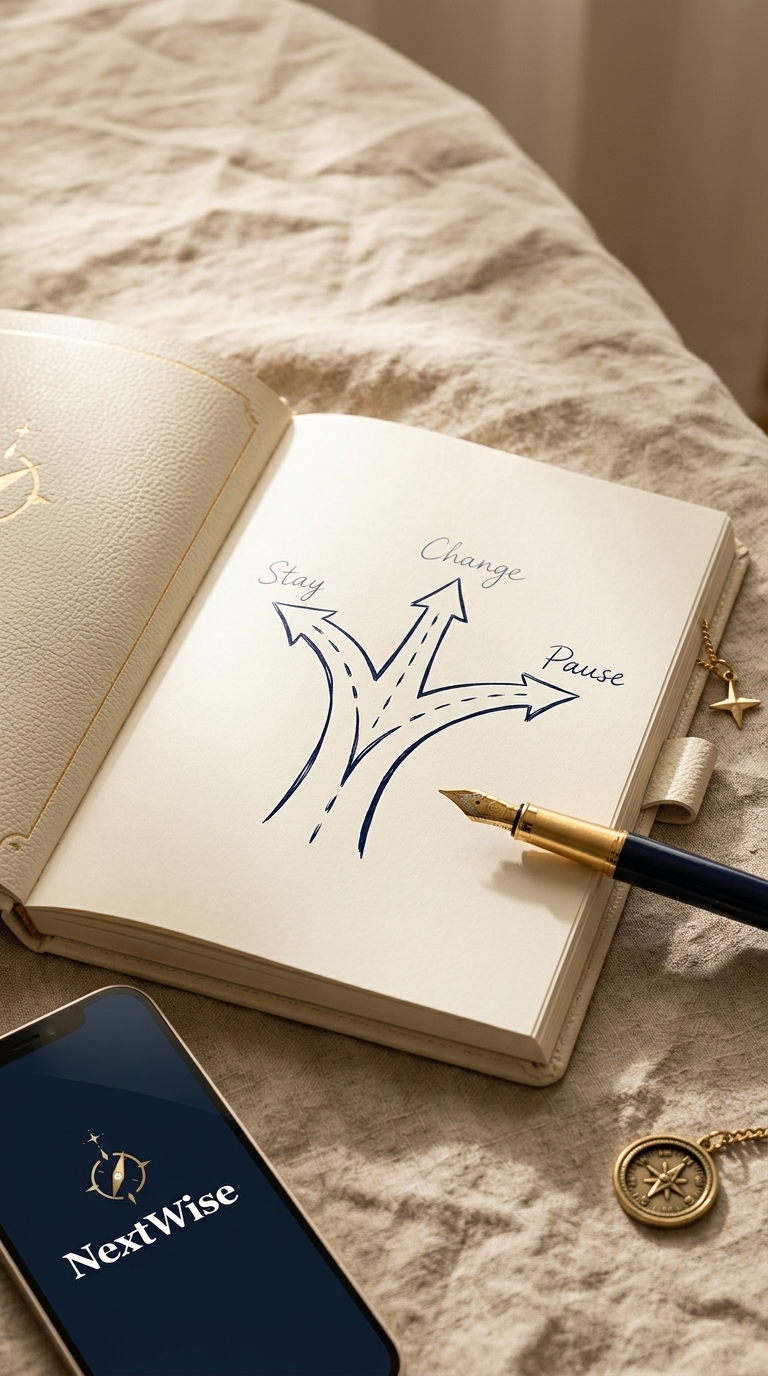
!Decision fork on paper — mapping the paths before choosing
---
How NextWise Addresses This Specifically
NextWise is a structured decision-mapping tool built for exactly these moments — not the trivial choices, but the ones that keep you up at night.
At the core of how NextWise works is a process called the 3-Layer Filter. Rather than giving you a blank canvas or a generic questionnaire, it takes you through three distinct layers of analysis:
Layer 1 — Facts vs. Assumptions. Most decisions feel more complicated than they are because facts and assumptions are mixed together in our heads with equal weight. This layer forces a clean separation. What do you actually know? What are you assuming? Which assumptions, if wrong, would change everything?
Layer 2 — Risks & Blindspots. This is where most people skip ahead. The second layer maps not just the obvious risks you have already thought about, but the ones sitting in your peripheral vision — the things you have been avoiding looking at directly. These are almost always the factors that determine whether a decision works out.
Layer 3 — 7-Day Action Plan. A decision without a concrete next step is just a thought. The third layer converts your clarity into a specific, dated sequence of actions — small enough to be real, structured enough to actually happen.
The result is not a recommendation handed to you by an algorithm. It is a map that reflects your own thinking, organized in a way that reduces the cognitive overhead and makes the path forward visible.
---
A Practical Approach to Starting Right Now
Before you open another browser tab or ask another friend for their opinion, try this:
1. Write down the decision you are facing in one sentence. 2. Underneath it, write three things you *know for certain* about the situation. 3. Write three things you are *assuming* but have not verified. 4. Identify the single biggest risk you have been avoiding thinking about. 5. Write down one action you could take in the next seven days that would give you more information or move you meaningfully forward.
This five-step exercise takes about ten minutes. It will not solve everything. But it will interrupt the loop — the repetitive, unproductive mental cycling that characterizes decision fatigue at its worst.
If you want to go deeper, NextWise runs you through this entire process in a structured, guided format built specifically for life decisions.
---
When to Stop Analyzing and Just Decide
There is a point in every meaningful decision where more information stops helping and starts becoming avoidance. Recognizing that point is a skill.
A useful signal: if you have gathered the same type of information more than twice, and each new piece is not significantly changing your thinking, you have likely crossed from research into stalling. The discomfort you are feeling is not a sign that you need more data. It is a sign that you need to make a commitment and live with the uncertainty that comes with it.
Perfect information does not exist. Every significant life decision is made with incomplete information, some degree of risk, and no guarantee. The goal of good decision-making is not to eliminate uncertainty. It is to make a clear-eyed choice despite it — and to do so before fatigue makes the choice for you.
---
Ready to stop circling and start moving?
> ### Map Your Decision With NextWise > You have been thinking about this long enough. NextWise walks you through the 3-Layer Filter — separating facts from assumptions, surfacing the risks you have been avoiding, and building a 7-day action plan that actually fits your life. > > Start your free decision map → /start?category=life
---
The Cumulative Effect of Better Decisions
Overcoming decision fatigue is not really about making any single choice faster or more efficiently. It is about the cumulative effect of protecting your cognitive resources so that the decisions that genuinely shape your life receive the quality of thinking they deserve.
The person who systematizes the trivial things is not lazy. They are strategic. They have accepted that mental energy is finite and chosen to spend it wisely.
Your best thinking deserves your best conditions. That means timing your important decisions well, using structures that support rather than replace your judgment, and — when the stakes are high enough — using tools that help you see your own situation more clearly than you can from inside it.
You are not going to think your way to clarity by thinking harder. You are going to get there by thinking more deliberately, with better scaffolding, at the right time of day. That is it. That is the whole answer.